Presentation is everything! How often we've heard that adage in food preparation. It's the mantra of
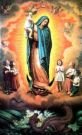
Food Channel addicts everywhere. But today Eastern Christians as well as those of us in the West celebrate another kind of presentation, the Presentation of the Blessed Virgin Mary. And Her presentation tells us everything we need to know about Her and Her God.
Mary's presentation isn't specifically mentioned in Scripture. However, presentations of children are a commonplace theme in Hebrew tradition, from Samuel the prophet to John the Baptist. Extraordinarily pious parents were often expected to dedicate their children to the Lord, sometimes leaving them in the Temple precincts for upbringing and education.
So, it is no surprise to find in early Christian tradition (c. 120-170) a rather lengthy treatment of Mary's early life. The Protoevangelium of James recounts Anne's hesitation at bringing Mary to the Temple at the tender age of two and Joachim's aquiesence. Mary's special status is clearly recognized. Anne makes her bedroom a shrine or sanctuary to protect her. And when Mary is finally presented to the Lord at age 3, she hears the angelic choirs and dances to their music on the steps of the Temple.
Is it really so unexpected to see such reverence for our Blessed Mother so early in the tradition? The Protoevangelium utilizes motifs and language drawn from the infancy narratives in Matthew and Luke. The later Marian doctrines (her sinlessness, her closeness to God) are not outlined clearly. But the author of this second century book clearly understands Mary as possessing a very special place in salvation history, close to the Holy Heart of God.
And so she is.
I have found her to be all that the Church claims for her, and more. St Augustine of Hippo puts Mary in her proper, though exalted, place as the One who first did the will of the Father in bringing His Son to earth. We need to follow her as she follows God. We pray with Mary "let it be done to me according to Your Word."
From a sermon of Augustine (Today's Office of Readings):
Stretching out his hand over his disciples, the Lord Christ declared: Here are my mother and my brothers; anyone who does the will of my Father who sent me is my brother and sister and my mother. I would urge you to ponder these words. Did the Virgin Mary, who believed by faith and conceived by faith, who was the chosen one from whom our Saviour was born among men, who was created by Christ before Christ was created in her – did she not do the will of the Father?
Indeed the blessed Mary certainly did the Father’s will, and so it was for her a greater thing to have been Christ’s disciple than to have been his mother, and she was more blessed in her discipleship than in her motherhood. Hers was the happiness of first bearing in her womb him whom she would obey as her master.
Now listen and see if the words of Scripture do not agree with what I have said. The Lord was passing by and crowds were following him. His miracles gave proof of divine power. and a woman cried out: Happy is the womb that bore you, blessed is that womb! But the Lord, not wishing people to seek happiness in a purely physical relationship, replied: More blessed are those who hear the word of God and keep it.
Mary heard God’s word and kept it, and so she is blessed. She kept God’s truth in her mind, a nobler thing than carrying his body in her womb. The truth and the body were both Christ: he was kept in Mary’s mind insofar as he is truth, he was carried in her womb insofar as he is man; but what is kept in the mind is of a higher order than what is carried in the womb.The Virgin Mary is both holy and blessed, and yet the Church is greater than she.
Mary is a part of the Church, a member of the Church, a holy, an eminent – the most eminent – member, but still only a member of the entire body. The body undoubtedly is greater than she, one of its members. This body has the Lord for its head, and head and body together make up the whole Christ. In other words, our head is divine – our head is God.
Now, beloved, give me your whole attention, for you also are members of Christ; you also are the body of Christ. Consider how you yourselves can be among those of whom the Lord said: Here are my mother and my brothers. Do you wonder how you can be the mother of Christ? He himself said: Whoever hears and fulfils the will of my Father in heaven is my brother and my sister and my mother.
As for our being the brothers and sisters of Christ, we can understand this because although there is only one inheritance and Christ is the only Son, his mercy would not allow him to remain alone. It was his wish that we too should be heirs of the Father, and co-heirs with himself. Now having said that all of you are brothers of Christ, shall I not dare to call you his mother? Much less would I dare to deny his own words.
Tell me how Mary became the mother of Christ, if it was not by giving birth to the members of Christ? You, to whom I am speaking, are the members of Christ. Of whom were you born? “Of Mother Church”, I hear the reply of your hearts. You became sons of this mother at your baptism, you came to birth then as members of Christ.
Now you in your turn must draw to the font of baptism as many as you possibly can. You became sons when you were born there yourselves, and now by bringing others to birth in the same way, you have it in your power to become the mothers of Christ.
Mother of the Church, Mother of our Lord, Mother of us all, pray for us, that we may hear and heed God's Word.