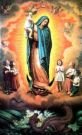
Today is the 20th anniversary of my mother's death. It's also the Feast of the Nativity of the Blessed Virgin Mary. In so many ways, I feel that Mary has become even more my Mother since my mom's passing... not taking her place, but continuing that unconditional merciful caring that my mom consistently showed to me.
However, that love isn't just or even primarily maternal. That love springs from a Source even deeper and more profound. I see the tableau of Jesus on the Cross over the figures of Mary and the Beloved Disciple. In that moment the purpose of Mary's birth was fulfilled. The Son whom she bore was bearing our sins away forever. That's the true Love of which maternal love is an imperfect although very beautiful image.
Then I see the great transaction- signaled by Jesus' handing over of His Mother to her new son, John. "Son, behold your mother.... Mother, behold your son." In those words Jesus not only commited his Mother to the care of the Beloved disciple. He also created a new relationship for me, for all of us, with the Mother of All Souls. She cares for us, and we care about Her.
So, today I am thankful for my earthly mother. And just as much for my heavenly Mother.
I know I've been posting a lot of B-16 recently. But here are some irresistable paragraphs from the Holy Father's Homily at Mariazell for the Nativity of Mary.
"To gaze upon Christ" is the motto of this day. For one who is searching, this summons repeatedly turns into a spontaneous plea, a plea addressed especially to Mary, who has given us Christ as her Son: "Show us Jesus!" Let us make this prayer today with our whole heart; let us make this prayer above and beyond the present moment, as we inwardly seek the Face of the Redeemer.
"Show us Jesus!" Mary responds, showing him to us in the first instance as a child. God has made himself small for us. God comes not with external force, but he comes in the powerlessness of his love, which is where his true strength lies. He places himself in our hands. He asks for our love. He invites us to become small ourselves, to come down from our high thrones and to learn to be childlike before God. He speaks to us informally. He asks us to trust him and thus to learn how to live in truth and love.
The child Jesus naturally reminds us also of all the children in the world, in whom he wishes to come to us. Children who live in poverty; who are exploited as soldiers; who have never been able to experience the love of parents; sick and suffering children, but also those who are joyful and healthy. Europe has become child-poor: we want everything for ourselves, and place little trust in the future. Yet the earth will be deprived of a future only when the forces of the human heart and of reason illuminated by the heart are extinguished -- when the face of God no longer shines upon the earth. Where God is, there is the future.
"To gaze upon Christ": let us look briefly now at the Crucified One above the high altar. God saved the world not by the sword, but by the Cross. In dying, Jesus extends his arms. This, in the first place, is the posture of the Passion, in which he lets himself be nailed to the Cross for us, in order to give us his life. Yet outstretched arms are also the posture of one who prays, the stance assumed by the priest when he extends his arms in prayer: Jesus transformed the Passion, his suffering and his death, into prayer, and in this way he transformed it into an act of love for God and for humanity. That, finally, is why the outstretched arms of the Crucified One are also a gesture of embracing, by which he draws us to himself, wishing to enfold us in his loving hands. In this way he is an image of the living God, he is God himself, and we may entrust ourselves to him.
"To gaze upon Christ!" If we do this, we realize that Christianity is more than and different from a moral code, from a series of requirements and laws. It is the gift of a friendship that lasts through life and death: "No longer do I call you servants, but friends" (Jn 15:15), the Lord says to his disciples. We entrust ourselves to this friendship. Yet precisely because Christianity is more than a moral system, because it is the gift of friendship, for this reason it also contains within itself great moral strength, which is so urgently needed today on account of the challenges of our time. If with Jesus Christ and his Church we constantly re-read the Ten Commandments of Sinai, entering into their full depth, then a great, valid and lasting teaching unfolds before us.
The Ten Commandments are first and foremost a "yes" to God, to a God who loves us and leads us, who carries us and yet allows us our freedom: indeed, it is he who makes our freedom real (the first three commandments). It is a "yes" to the family (fourth commandment), a "yes" to life (fifth commandment), a "yes" to responsible love (sixth commandment), a "yes" to solidarity, to social responsibility and to justice (seventh commandment), a "yes" to truth (eighth commandment) and a "yes" to respect for other people and for what is theirs (ninth and tenth commandments). By the strength of our friendship with the living God we live this manifold "yes" and at the same time we carry it as a signpost into this world of ours today.
"Show us Jesus!" It was with this plea to the Mother of the Lord that we set off on our journey here. This same plea will accompany us as we return to our daily lives. And we know that Mary hears our prayer: yes, whenever we look towards Mary, she shows us Jesus. Thus we can find the right path, we can follow it step by step, filled with joyful confidence that the path leads into the light -- into the joy of eternal Love. Amen."