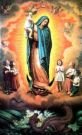
Showing posts with label Sacred Heart of Jesus. Show all posts

Wednesday, September 05, 2007

Mother Teresa's Heart of Darkness

"To be alone with Jesus in adoration and intimate union with Him is the Greatest Gift of Love - the tender love of Our Father in Heaven."

- Blessed Mother Teresa of Calcutta

Interesting quote from Mother Teresa, especially in light of recent "revelations" about her dark moods and decades-long feelings of adandonment. If you put this quote right up next to those darkest of moments, what happens?

One response is to see in Mother Teresa symptoms of a systemic problem. We are all familiar with the best-seller question: why do bad things happen to good people? But the question becomes even more acute when one internalizes the whole experience, the problem of suffering writ small, on the tablet of the human soul

The question then goes like this: how could a loving God tolerate provoking feelings of abandonment in His children, imposing on them decades of emotional suffering? Christopher Hitchens blames the situation (as he frequently does) on organized religion. Hitchens is headed along the right trail, but he doesn't go far enough along it to view the true source of Teresa's angst.

The "crushing unreasonableness" is not a burden imposed on weak souls by the Church itself, as if some internal belief system were the source of Teresa's emotional suffering. It's much deeper, much more profund than that.

The imprint of this unreasonableness finds its source in the Heart of God himself, especially as that Heart reveals its powerful Self in the Sacred and Immaculate Hearts of Jesus and Mary. These two hearts are not direct doorways to sweetness and light, as those who persevere in these twin devotions know.

There is in their midst a Heart of Darkness.

Inside of that Heart there are the teeming poor,wretched souls from Bosnia and hopeless people dying of AIDS. Inside of that Heart are all of the external circumstances which weigh down the world. These are the very wounds which Blessed Teresa of Calcutta herself loved and dressed in the body of this aching world. Like the Sacrament, there are in this Heart the Body broken, and the blood outpoured.

So, it should come as no surprise when a saint's life reveals an inward desolation, a barreness seemingly God-forsaken. It is precisely there where the fruit of love is born. It is precisely and only in the Heart of Darkness that we begin to experience the resurrection light. It is only those who have been there, or at least peered into the Mystery, who understand this divine necessity. It is the necessity which drove our Lord to His Cross. It is the divine necessity which drives His people to sacrifice themselves in lives of service.

Blessed Mother Teresa was not a saint in spite of her inward turmoil, but precisely because of it.
Enough said.

Thursday, June 14, 2007

Sacred Heart Devotion: Part of a Balanced Spiritual Diet

I have been pondering the many fine posts I've seen the past day or so on the Sacred Heart of Jesus. I can't hope to equal them, especially several of Father Mark's meditations at Vultus Christi. I know, I've mentioned him twice in as many days, but he really is THAT good. Check them out.

Reading his posts allowed me to go back and explore some earlier discoveries of my own from when I was still Lutheran, in the early 1990's. Here is a picture similar to one which I picked up at a garage sale many, many years ago. It had hung in my Pastor's study all through my years of pastoral ministry. It is an old fashioned etching of the Sacred Heart of Jesus from a Benedictine Monastery in Clyde MO.

Even as a Lutheran, I was always fascinated by this picture and the warm devotional consecration prayer underneath the picture. I even preached on the Sacred Heart once at my Lutheran parish... and used the picture as an illustration.

Devotion to the Sacred Heart was one way (among others) back then in which I could appropriate the truth of the Catholic faith without having to deal with the rest of the bundle of truths and practices which make up the Catholic Faith. It worked for a while, but even back then I sensed that the warmth of Sacred Heart devotion, seemingly so akin to the "love of Jesus" demonstrated by us Evangelicals, was really void of any power of its own.

The warmth of the emotion is fine, and very necessary to spiritual well-being. But, like anything else in the spiritual life, it does its work best when it forms a part of a larger whole. For me, that larger whole came into being many years later.
It happened once I began to explore not just the intellectual truths of Catholicism, but actually began to practice them. Frequent communion, personal and corporate prayer, regular confession and the Rosary are what it took for all the fine ideals of those earlier days to take concrete form in my life.
Of course, getting fixated on any particular devotion to the exclusion of all else can be one way of avoiding spiritual growth. We've all known Divine Mercy gurus, or Centering Prayer..., or Daily Office... or Lectio Divina .... gurus.
It's all they practice. It's what they swear by, for themselves and sometimes for everyone else. They seem to be Johnny-One Note practitioners of Catholicism. A good cure for that is to get a little dose (cynics would say- innoculation) of everything Catholic. I think it helps us have a balanced Faith life. Not doing so is like eating a diet of just one food... even if its healthy food. The same-ness of it all is just not good for you.

I remember back when I was a Protestant reading the book The Devotion to the Sacred Heart of Jesus: How to Practice the Sacred Heart Devotion. The book was penned by Fr. John Croiset, S.J. at the end of the 1600's. He was spiritual director to St. Margaret Mary. She popularized this ancient and venerable form of devotion as a kind of antidote to the prevailing intellectualism and scholasticism of her own day.

Anyway, I went back today and skimmed through the book itself once again. There I re-discovered awide range of practices and ideas that formerly which had seemed so foreign to me back then. Now they are now part of the warp and woof of my life. For example, here are some of the means the book prescribes for acquiring the perfect love of Jesus:

prayer,
frequent communion,
visits to the Blessed Sacrament,
tender devotion to the Virgin Mary.
How strange and foreign all of these concepts were to me back then. And, oh the contrast, now that they have entered my life and, to be truthful, given me new life in Him.
So I guess today that I am thankful for the small progress that I have begun to make in the Christian life, and praying always that it may continue and increase.

"One day I saw the Son of God, holding in his Hand His own Heart,
which appeared more brilliant than the sun
and which was casting rays of light on every side;
then, this amiable Savior gave me to understand
that all the graces which God unceasingly pours forth on men,
according to the capacity of each,
come from the plenitude of the Divine Heart."

-Saint Mechtilde (quoted by Fr. Croiset)

More about Father Ragheed Ganni: Courageous Witness

"Having Taught a Martyr Is Something Else Entirely"

Professor Shares E-Mails From Father Ragheed

ROME, JUNE 13, 2007 (Zenit.org ).-

"The situation here is worse than hell," Father Ragheed Ganni wrote to a former professor the day before he and three deacons were shot after Sunday Mass in Mosul, Iraq.Father Robert Christian, a theology professor at the Pontifical University of St. Thomas Aquinas, the Angelicum, in Rome, spoke at the requiem Mass held in that school on Tuesday. There, Father Ganni had studied theology and ecumenism.

On June 3, Father Ganni and three deacons, Basman Yousef Daoud, Ghasan Bidawid and Wadid Hanna, were killed in front of the Church of the Holy Spirit. Father Christian began his homily, saying: "On Saturday, June 2, I received an e-mail from Mosul. In part it read: 'The situation here is worse than hell, and my church has been attacked a few more times since we last met. Last week, two guards in it were wounded after an attack. We shall meet in the near future and have a chat about all these events. God bless, Ragheed.'"

Father Christian continued: "The patriarch of the Chaldeans called them martyrs. And martyrs, who conform closely to the passion and death of Jesus Christ, have been revered since Christian antiquity as saints."A hellFather Christian called a hell that which "those left behind are experiencing: Ragheed's family and friends; the flock he pastured; his Chaldean Church, other Christians, and yes, Muslims, too, trapped in the senseless vortex of blind hatred and violence that is daily life in Iraq.""Ragheed could have fled," Father Christian continued. "As far as I know, he came to Italy three times after he returned to Mosul upon finishing his licentiate in ecumenism at the Angelicum. "But Ragheed had a strong sense of his priestly duty to be an icon of the Good Shepherd for his people."

Father Christian also read a message he received from Father Ganni last October. It read:

"Dear Father Christian, How are you? I'm really happy to get your message, and to know that there are people who still think of and pray for my country." The situation, as you can follow in the news, is dreadful. Christians are suffering twice, first because of the situation, second because of their religion.

"The Pope's speech lit a fire in the city. A Syrian Orthodox priest was beheaded; my parish church was attacked five times. I was threatened even before that priest was kidnapped, but I was very careful about moving around. I postponed my vacation twice because I couldn't leave the city under such conditions.

"I was planning to travel to Europe on Sept. 18, but I moved it to Oct. 4. Then I had to change the date to Nov. 1. "Ramadan was a disaster for us in Mosul. Hundreds of Christian families fled outside the city -- including my family and uncles. About 30 people left all their properties and fled, having been threatened."It is not easy but the grace of the Lord gives support and strength. We face death every day here."

These words show, Father Christian said, that Father Ganni "knew he was facing the threat of death for his faith. But he also knew that staying there was his duty, giving courageous witness to our faith in the resurrected Lord."

The professor continued: "We are used to teaching future leaders of the Church. When we hear about one of our former students becoming a bishop, we rejoice. But having taught a martyr is something else entirely. And sometimes we professors learn from our students."The emotions are strong: sadness, pain, anger and the feeling of helplessness.

"However, there is the awareness that we are before a person who was prepared to pay the supreme price; a person who wanted to live and die heroically; a person ready to shed his blood for the life of the faithful. This awareness humbles us."

Father Christian explained the source of Father Ganni's fortitude: "The strength of Father Ragheed was the Eucharist, and in his homilies he taught the faithful that the body and blood of Jesus, who was sacrificed and resurrected, strengthened the union among the members of the mystical body of Christ. "May the Eucharist give us the courage to live and die like Father Ragheed."Giving into the temptation of revenge does not honor Father Ragheed, but rather promoting peace, dialogue, and constructing or building a civilization of love."

On Sunday, another requiem Mass was celebrated by Father Joseph Chedid in the Church of St. Roukoz of the Antonine Maronite order in Lebanon.In his homily, Father Chedid, an Antonine priest and friend of Father Ragheed, spoke about the "souls of the martyrs whose blood was shed to witness to the word of God." He asked the faithful to pray to the Sacred Heart of Jesus for the Iraqi people, and especially for Christians, to remove the "dark clouds hanging over them during the dreadful situation they are experiencing."

Sacred Heart of Jesus, pray for all the people affected by this war
and for us who have recourse to you.