Tuesday, October 31, 2006

On Caring about Others


There's a reason why he was called Chrysostom, golden mouthed, and one can see how he could get himself exiled from the Imperial Capital. He really tells it like it is.

From St. John Chrysostom http://www.chrysostom.org/ (around 345-407), Archbishop of Constantinople
Homily 20 on the Acts of the Apostles


Being yeast for the world

Nothing is more derisory than a Christian, who does not care for the salvation of others. You cannot here plead poverty: for the poor widow that put in two small coins, shall be your accuser (Mk 12:42). And Peter said to the crippled man: "I have neither silver nor gold." (Acts 3:6) And Paul was so poor, that he was often hungry. You cannot plead lowness of birth: for the apostles too were simple men, and of simple parentage. You cannot allege want of education, for they too were unlearned. Even if you were a slave and a runaway, you could perform your part; for such was Onesimus, yet how much Paul honors him (Phl). You cannot plead infirmity, for such was Timothy. No matter who we are, everyone can profit his neighbor, if he will fulfil his part.

Consider the trees in the forest, how strong they are, how fair and of great height. But if we had a garden we would much rather have pomegranates, or fruitful olive trees. Fair trees but unfruitful…, such are people who only consider their own interest… If the leaven mixed up with the flour did not change the whole into its own nature, would such a thing be leaven? If a perfume shed no sweet odor on those who approach it, could we call it a perfume? Therefore, don't say, "It is impossible for me to be a good influence on others".

For if you are a Christian, it is impossible not to: it is the very nature of Christians… For it is easier for the sun not to give heat, nor to shine, than for the Christian not to send forth light."

Monday, October 30, 2006

More Light on Blind Bart from B. XVI


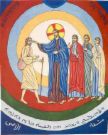
Benedict XVI had this to say about Sunday's gospel encounter between Bartemaeus and Jesus, an event whose decisive moment, he said, was the "personal, direct encounter between the Lord and that man who was suffering."


"They are before one another: God with his will to cure and the man with his desire to be cured," the Pope observed. "Two liberties, two converging wills."The blind man's entreaty, full of faith, ends in the miracle. "God's joy, man's joy," said the Holy Father.

And from that moment, Bartimaeus became a disciple of Jesus, "and he goes up with the Master to Jerusalem to take part with him in the great mystery of salvation," the Pontiff recalled. The account "evokes the itinerary of the catechumen toward the sacrament of baptism, which in the early Church was also called 'Illumination,'" because the "faith is a path of illumination," noted Benedict XVI.

"It starts from the humility of acknowledging one's need of salvation and arrives at the personal encounter with Christ, who calls to follow him on the way of love. "It is from this model that "the itineraries of Christian initiation have been established in the Church, which prepare for the sacraments of baptism, confirmation and the Eucharist," he stated.

And in places where baptism is received as a child, the Pope continued, "catechetical and spiritual experiences are proposed to young people and adults which enable them to undertake a path of rediscovery of the faith in a mature and conscious way, in order to assume later a coherent commitment to witness." The task carried out by pastors and catechists in this field is crucial, the Holy Father said. "The rediscovery of the value of one's baptism is the basis of the missionary commitment of every Christian."The Gospel shows that he who lets himself be fascinated by Christ cannot do without witnessing the joy of following in his footsteps. "He concluded: "We understand even more that, in virtue of baptism, we have an inherent missionary vocation."

Sunday, October 29, 2006

Jesus is calling you

I heard these words today at Mass, spoken to blind Bartimaus in the gospel reading, as if spoken to me. "Take courage, get up, Jesus is calling you." He is calling us all, all of us, each and every one who humbly cries out to him to come and help us in our infirmity. It is interesting to me to note the similarity between blind Bartimaus' prayer response and the traditional Jesus prayer one version of which is "Jesus Christ, Son of God, have mercy on me, a sinner."

Both are humble cries for help, both are addressed to the same saving Lord. Both prayers are the cry of hearts who know their deep need. There have been some times in my life, even recently, when all I could manage to pray was this Jesus Prayer. It is enough.

I also heard today that wonderful English hymn, with words by George Herbert and featuring a haunting melodic setting by Ralph Vaughan Williams. The title of the melody is as tantalizing as the musical notes themselves. I wish I was techno-saavy enough to provide you a link to the composition. But the words alone will have to suffice. It's simply entitled "the Call."

You'll forgive me if I share all three stanzas:

Come, my Way, my Truth, my Life:
Such a way as gives us breath;
Such a truth as ends all strife;
Such a life as killeth death.

Come my Light, my Feast, my Strength;
Such a light as shows a feast;
Such a feast as mends in length;
Such a strength as makes his guest.

Come my Joy, my Love, my Heart;
Such a joy as none as come move;
Such a love as none can part;
Such a heart as joys in love.

Tonight I pray again "Come, Lord Jesus, have mercy on me, a sinner."